

The following post contains affiliate links, which sends me a small percentage of any sales at no cost to you.
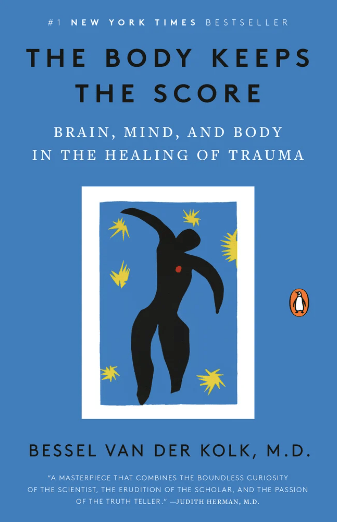
I recently finished a book I bought years ago, “The Body Keeps the Score: Brain, Mind, and Body in the Healing of Trauma” by Bessel Van Der Kolk, M.D.
I know a lot of people have read this book — if you have, I’d be curious to hear your thoughts and takeaways — I hadn’t heard of it until someone I follow on social media posted about it.
It sat on my shelf for a long time, but I think, on some level, I knew I needed to wait until I was ready to read it.
Dr. Bessel van der Kolk is one of the world’s foremost experts on trauma and has spent over three decades working with survivors.
In the book, he shares recent scientific advances to show how trauma literally reshapes the body and brain, compromising sufferers’ capacities for pleasure, engagement, self-control, and trust.
He also explores innovative treatments–from neurofeedback and meditation to sports, drama, and yoga–that offer new paths to recovery by activating the brain’s natural neuroplasticity.
Generally speaking, I was blown away by this book. Dr. Bessel van der Kolk’s research is so impressive, and it’s a true gift to be able to read so much information in one book.
There are also several images in the book including brain scans, drawings, and charts that are helpful in understanding the research.
The most fascinating parts of the book (for me) were regarding how the brain reacts to trauma and how it affects our memory and life after the fact.
Although many of the patient stories were less relatable, I found hope in knowing that people who went through incredible trauma have made significant progress in their lives.
I highlighted SO much of this book, and I’ll share some of my highlighted lines with you:
Quotes from ‘The Body Keeps the Score’
Part one: The Rediscovery of Trauma
- How do horrific experiences cause people to become hopelessly stuck in the past? What happens in people’s minds and brains that keeps them frozen, trapped in a place they desperately wish to escape?
- Trauma, whether it is the result of something done to you or something you yourself have done, almost always makes it difficult to engage in intimate relationships.
- We have learned that trauma is not just an event that took place sometime in the past; it is also the imprint left by that experience on mind, brain, and body. This imprint has ongoing consequences for how the human organism manages to survive in the present.
Part two: This is Your Brain on Trauma
- Being traumatized means continuing to organize your life as if the trauma were still going on — unchanged and immutable — as every new encounter or event is contaminated by the past.
- Constantly fighting unseen dangers is exhausting and leaves them fatigued, depressed, and weary.
- Being anchored in the present while revisiting the trauma opens the possibility of deeply knowing that the terrible events belong in the past.
Part three: The Minds of Children
- Traumas is not stored as a narrative with an orderly beginning, middle, and end.
Part four: The Imprint of Trauma
- There have in fact been hundreds of scientific publications spanning well over a century documenting how the memory of trauma can be repressed only to resurface decades later.
- Traumatic memories are fundamentally different from the stories we tell about the past. They are dissociated: The different sensations that entered the brain at the time of the trauma are not properly assembled into a story, a piece of autobiography.
Part five: Paths to Recovery
- At the core of recovery is self-awareness.
- When we pay focused attention to our bodily sensations, we can recognize the ebb and flow of our emotions and, with that, increase our control over them.
- People cannot put traumatic events behind until they are abe to acknowledge what has happened and start to recognize the invisible demons they’re struggling with.
- Silence about trauma also leads to death — the death of the soul. Silence reinforces the godforsaken isolation of trauma.
… I highlighted much more, but I know everyone who reads this book will take away something different.
I would definitely recommend this book to anyone who’s suffered trauma (even if they’re not sure what trauma is) or anyone interested in how the brain and body work together in terms of mental health.
For more book recommendations, be sure to subscribe to the blog (look to the right) and follow me on Goodreads @thebitterlemon – where I share more of my book picks. Also, check out my printable bookmarks and Book Club Journal Pages in my Etsy Shop.
 The Bitter Lemon
2 Comments