
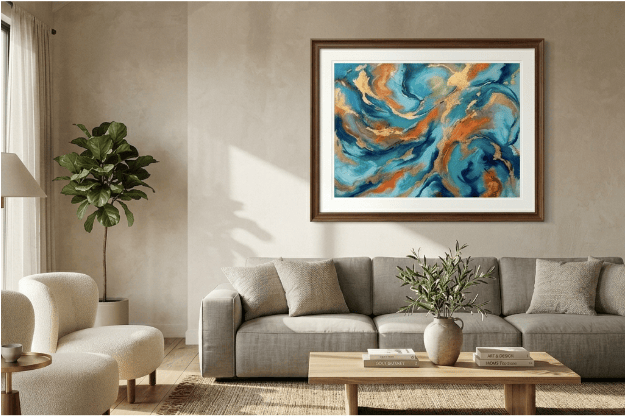
Figuring out how much to spend on art for your home is harder than it should be. Prices run from a few dollars for a poster to the cost of a used car for a major painting, and the middle of that range is where most of us get stuck. Here’s how I’d think about it: what each budget actually gets you, why size often beats exclusivity on a tight budget, and what to plan for beyond the price tag.
What Different Budgets Actually Buy
Under about $500, you’re mostly shopping for prints, works on paper, small paintings, and limited editions. Most pieces at this level are modest in scale, so one frame on a big wall can look a little lost. If the budget is tight, a grouping of two or three matching prints often reads better than a single small piece.
Around $1,000 to $2,500 is where you start to see more options. You can find medium to large pieces that anchor a living room wall or an entryway, along with more complex compositions and large-format photography. Is this extra investment worth it? A Buildworld survey of 1,016 respondents found that people who spent at least $1,500 on art were happier with their overall living space than those who spent no more than $200. That’s self-reported and correlational, so it doesn’t prove art causes happiness. Still, it suggests a few well-chosen pieces are money well spent.
Above $5,000, you’re into oversized works, sculpture, and installation pieces. Most homes don’t need that, but a double-height entryway or a long blank wall can justify it.
Size Versus Exclusivity
Below roughly $1,000 to $1,500, money goes further in size than in exclusivity. That’s the trade-off I’d focus on first. The same logic applies to prints. Canvas from online sellers such as Crib of Art can fill a large wall for well under what a small signed original costs, which is the right trade below that threshold. A well-sized canvas can make a room feel more balanced and inviting.
Above that line, the case for a real original gets stronger. You’re paying for one piece, the artist’s hand, and a story you’ll enjoy telling.
What Size Does to the Price
Price per square inch is the clearest way to see the size argument. An Art House SF survey of 107 emerging artists found about $2.85 per square inch for paintings 10 to 20 inches on a side, $2.80 for 20 to 30 inches, and $1.80 for pieces 30 inches or more. By that math, an 18 by 24 inch original lands near $1,200, while a 36 by 48 inch piece comes in around $3,100. The survey notes that works outside these ranges can still be worth the price, especially from artists with a sales history or gallery representation. It comes from a gallery, so treat the figures as a benchmark rather than a price list.
The Rest of the Room Matters Too
Art is rarely the biggest line item in a living room. A sofa usually costs more, so it helps to know that number before you decide how much wall art you can afford. I wrote about one big-ticket buy in my JACH modular sectional review, and the same budgeting logic applies to the walls.
Framing is the cost people forget. A frame can add a surprising amount to a print’s price, so ask for the framed total before you compare options. A cheap print in an expensive frame can cost more than a better print in a simple one.
Soft goods are the cheapest way to finish a room. I’ve written up the best pillows I’ve ever bought, and they’re a low-risk way to test a color palette before committing to a large canvas.
How Much Do Serious Collectors Spend?
If your budget feels small, the data on art collectors is reassuring. The Art Basel and UBS survey of global collecting found that 77% of high-net-worth collectors spent under $50,000 in total on fine art in the first half of 2026. Those totals cover all purchases in that period, not per-piece prices, so they reflect the market more than what one painting should cost. Still, they show how wide the spending range is, and there’s no single correct number.
Frequently Asked Questions
How much should I spend on art for a living room?
Most living rooms do well with one large piece around $1,000 or more. Below that, consider a cluster of smaller works or one oversized print. Measure the wall first, then work backward to the budget.
Is $500 enough for good art?
Yes, as long as you’re realistic about scale. At this price, you’ll mostly find prints, works on paper, and small paintings or limited editions. Research the artist’s exhibition history, since that does more for long-term value than the frame does.
Are art prints worth buying?
They are, especially if you buy one for how a piece looks on your wall. Prints offer scale and variety at prices that originals rarely match. Choose good paper and a sensible frame, because the finish changes how a piece reads from across the room.
Is it better to buy one big piece or several small ones?
One large piece usually makes a stronger statement, especially above a sofa. A cluster works better in narrow spaces like hallways or over a console table. Let the wall decide.
How much should I budget for framing?
Plan for framing from the start, since it can add significantly to a print’s price. Ask for the framed total before comparing options. The frame can change which option is actually the better buy.
What is a fair price per square inch for original art?
An Art House SF survey of emerging artists found roughly $1.80 to $2.85 per square inch, with the lower end for the largest works. Use that as a sanity check, not a rule. An artist’s track record, gallery representation, or edition history can justify a higher price.
Should I buy original art or prints?
Buy originals when you love one specific piece and can afford it, since the price per inch tends to drop as the work gets bigger. Buy prints when you want a particular look on a tight budget. Neither choice is wrong, and plenty of good collections mix both.
Is it safe to buy art online without seeing it in person?
It can be if the listing has accurate dimensions, clear photos, and a return policy. Compare the piece’s size with a tape measure on your actual wall before you buy. Screens also distort color, so check the photos on a couple of devices.
Where can I find affordable work by emerging artists?
Art fairs, open studios, and artist-run online shops often list work below gallery prices. Local art school end-of-year shows are another reliable source. Buying directly from the artist usually skips the dealer’s markup.
Does art add value to a home?
Art makes a home feel finished, but it’s not a reliable way to add resale value. Buy pieces you’ll enjoy looking at for years, not ones you hope will appreciate. Treat the purchase as something for daily life first.
Putting It All Together
Start with the wall, not the price tag. Measure the space, decide how much visual weight it needs, and then set a budget that fits. Below roughly $1,000, size usually gets you more than exclusivity, and above that, an original becomes more compelling. What’s the most you’ve ever spent on a piece that still makes you smile?


You must be logged in to post a comment.