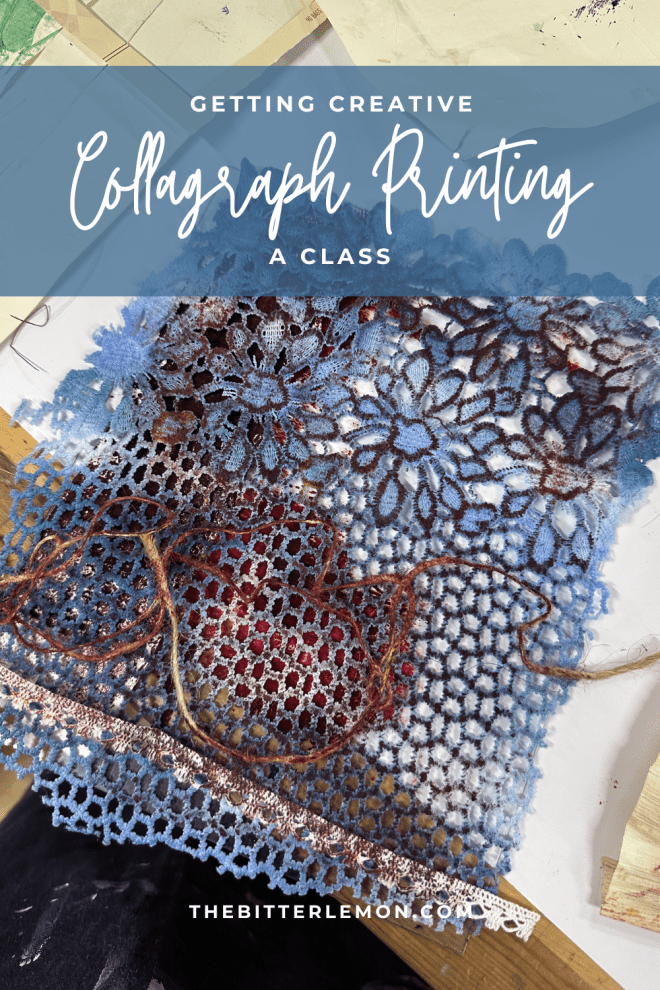
I’m continuing to tap into my creativity and have some fun by taking various classes at WNY Book Arts, and the most recent was a collagraph printing class.
Before taking this class, I’d never heard of collagraph printing, but I saw a photo of a finished print as part of the class marketing and thought it looked so pretty!
Turns out, collagraph comes from the word “collage,” which describes the way a “plate” for printing is created.
We started the class by looking at some finished prints, then began building our plates, which were basically collages of anything textured.
Our instructor had a collection of various lace, doilies, cardboard, feathers, mesh, corn husks, and twine, among other items.
We could arrange our choices on a plexiglass square and then paint over it all! This felt weird and a little wrong, but it was the next step!
From there, I placed my plate on the press, and the instructor placed a piece of paper that had been soaking in liquid (I’m assuming it was water, but am not certain) over it.
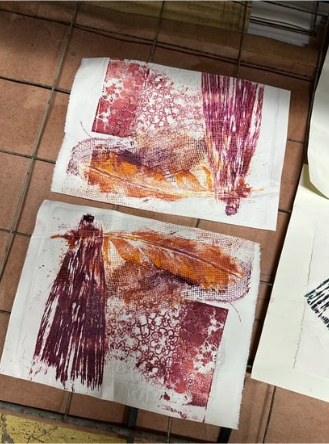
After placing several protective layers over the wet paper, it was time to print it by rolling the wheel on the press! Peeling all the layers back to reveal the print was always a fun surprise.
One thing I found truly interesting about this form of printing is how different the textures on the plate are when transferred to the print. After the initial print, you can make additional “ghost” prints by continuing to print without adding additional ink.
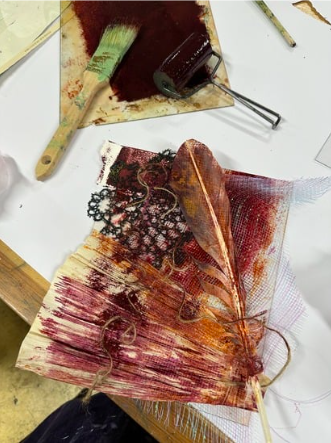
The instructor kept telling us “less is more” when it comes to ink; prints with very little ink often showed more detail in the textures than those inked with a heavier hand.
American artist Glen Alps invented and named the collagraph technique in 1955, and it gained popularity among artists in the 60s, particularly as a way to create abstract prints.
Today, its popularity stems from the fact that you can print with non-toxic materials, and it’s a fun way to reuse items that would otherwise be tossed!
I’ll share some photos I took during the class; it was 2.5 hours on a Saturday, and it was a great way to spend time indoors, since it’s still chilly here.
Although it felt weird to paint over the “collages” we were making, it made sense once I saw the first print. In just a few hours there, I made at least eight different prints and used various plates and ink colors.
I’m planning to frame at least one of my prints (and will keep the rest), I just haven’t decided which one yet!
Have you ever done collagraph printing? I’d love to know what you think of it, if so.
To see more writing from me, be sure to subscribe to The Bitter Lemon by clicking “subscribe” on the right side of your screen. Want even more? Subscribe to my newsletter to get roundups, book recs and lifestyle tips.
 The Bitter Lemon