

The following post contains affiliate links, which sends me a small percentage of any sales at no cost to you.
Happy Valentine’s Day!
There’s no better day than today to share my thoughts on two things I love: reading and music! Let’s get into my latest read…
After I finished reading Runnin’ With the Devil (the full review is here), I found myself wanting something more personal — something that centered Eddie’s voice rather than the full band mythology.
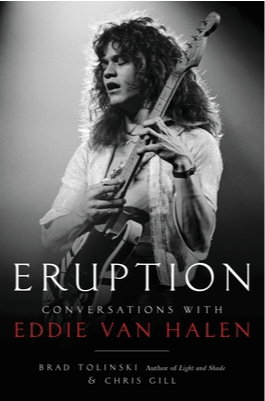
When I saw that my library had a copy of Eruption: Conversations with Eddie Van Halen, I grabbed it immediately.
If Runnin’ With the Devil zooms out, Eruption zooms in.
This book reads like a long, layered conversation with Eddie over decades.
It’s part narrative, part Q&A, built from hundreds of interviews Brad Tolinski and Chris Gill conducted with him throughout his life.
Because of that, there’s a rawness to it. You’re not just reading a neatly packaged legacy story — you’re watching a person evolve (and sometimes contradict himself) over time.
The Childhood That Surprised Me
One of the things that struck me most was Eddie’s childhood.
He described music as something that “saved his family.” That line stayed with me.
Before the arena tours and guitar-hero mythology, there was a young immigrant family trying to find stability and identity in America. Eddie’s father, Jan, was a successful musician in Amsterdam, and he left that career behind when the family moved to California.
The Van Halens didn’t have enough funds to cover their tickets to get to America, so Eddie and Alex performed on the ship to help cover the costs. For the Van Halens, music wasn’t just talent — it was survival, structure, purpose.
It made his almost obsessive devotion to the guitar make more sense (not that it needs to make sense). When something feels like it saved your family, you don’t treat it casually.
There’s a tenderness in those early stories that contrasts sharply with the hardened rock-star image people often associate with him.
The Genius — and the Complications
Of course, the book doesn’t shy away from the more complicated parts of Eddie either.
There are moments, especially in the later interviews, where he comes off as surprisingly cold. At one point, he takes a shot at solo artists, suggesting that someone only makes a solo record because they can’t communicate what they really want within their band, while also insisting that “every Van Halen album is my solo.”
That tension is fascinating.
On one hand, you see someone fiercely protective of the band identity. On the other, you see someone who built his own studio in his backyard and took creative control in ways that blur the line between collaboration and domination.
The story surrounding Van Halen III — widely considered a commercial disappointment — feels especially telling. It’s hard not to notice the irony between his comments about solo work and the way he ultimately steered that era of the band.
The book doesn’t editorialize much. It simply presents the interviews and lets you sit with the contradictions.
And honestly? That’s what makes it compelling.
Perspectives Beyond Eddie
Another strength of Eruption is its commentary from other musicians and bandmates, including David Lee Roth, Sammy Hagar, Tony Iommi, and Wolfgang van Halen.
Hearing how peers describe Eddie — his brilliance, his unpredictability, his singular ear — adds dimension.
No one seems to dispute his genius. But genius, as the book quietly suggests, doesn’t always equal emotional fluency or collaborative ease.
As a reader, you’re left holding both truths at once.
The Final Chapters
The last sections are hard to read.
There’s a sense that Eddie’s creativity was still alive — still curious, still restless — even as his physical and mental health deteriorated. It’s one of those deeply unfair artistic endings: a mind that still wants to create, paired with a body that can’t keep up.
It left me with a strange mix of admiration and sadness.
Is This the Definitive Portrait?
No single book is a complete portrait of a person — especially someone as mythologized as Eddie Van Halen.
But Eruption feels honest in a way that some rock biographies don’t. Because it draws from decades of interviews, you can see how his tone shifts over time. You see the bravado, the defensiveness, the pride, the vulnerability. You see the throughline of music as salvation — and the ego that inevitably comes with being revolutionary at something.
For me, this was a great addition to my ongoing exploration of iconic musicians. It doesn’t flatten Eddie into either hero or villain. It lets him be brilliant and contradictory and human.
And maybe that’s the most interesting version of him to read.
For more book recommendations, be sure to subscribe to the blog (look to the right) and follow me on Goodreads @thebitterlemon – where I share more of my book picks.
 The Bitter Lemon
One Comment